






PM testing procedure
The testing procedure
Specialised product testers, a binding evaluation handbook and a process documented at every stage: the PM procedure turns every test into a traceable, comparable result.

From product to test report
How a product test works
A result is only as reliable as the procedure behind it. That is why we disclose every step — from the arrival of the test sample to publication, uniformly regulated and traceable in every detail.
Test sample arrives
Completeness, packaging and labelling of the test sample are checked and fully documented.
Testing to the catalogue
Every test sample goes through the same standardised everyday test. Ten test parameters form one uniform benchmark.
Complete documentation
Testers with expertise in the respective category record every individual result in the test protocol.
Publication of the result
The protocol forms the basis of the evaluation report and the test report — published and accessible via the licence number for as long as the licence is valid.
The result cannot be bought. The testing fee is charged regardless of the outcome — it pays for the work, not the grade. Any influence on the result is ruled out by design.
Evaluation areas
Test criteria: what a product has to meet
Every result is made up of ten test parameters, grouped into three evaluation areas. The overview below shows each parameter and its weight in the overall grade, in points.
Area 01 · 33.3%
Product-specific properties
100 of 300 points
This is where the core of a product is decided: substance and craftsmanship. We test material quality, workmanship and design — the features you can feel in a shop but rarely compare objectively.
Quality & workmanship50
Covers material quality and craftsmanship — from the durability of the materials used to the precision of joints and surfaces. The benchmark is whether a product withstands everyday stress and keeps its value over time.
Design20
Assesses aesthetic impact and visual appearance, from colour to form. The question is whether the design concept is coherent and combines innovation with functional clarity.
Size & weight30
Checks physical dimensions and weight against the manufacturer’s specifications and for ergonomic suitability. The focus is on how well size and handling match the intended use.
Area 02 · 40.0%
Use and safety
120 of 300 points
A product proves itself in everyday use, not on the data sheet. This area tests whether it keeps its promise — works reliably, is intuitive to operate and poses no risks.
Functionality40
Examines performance, reliability and efficiency in actual operation. What counts is whether a product performs its intended tasks consistently and reliably under changing conditions.
Handling & suitability40
Assesses ease of use, ergonomics and suitability for the intended use. We test how intuitive a product is to operate and how convincingly it meets the needs of its target group.
Safety40
Identifies potential hazards and assesses protective mechanisms and compliance with relevant standards. The benchmark is whether a product poses no risk to the user when used as intended.
Area 03 · 26.7%
Opinion and service
80 of 300 points
Quality does not end with the product itself. This area looks at everything around it: whether advertising claims hold up in reality, how users experience the product in real use, and whether price, packaging and labelling are fair.
Advertising claims15
Compares advertised properties with the actual test results. The question is whether the stated benefits are delivered in real use in a traceable, verifiable way.
Consumer opinion20
Systematically evaluates feedback and reviews from real users. They capture experience from everyday use that complements standardised testing and completes the overall picture.
Packaging & labelling15
Assesses the protective function, material quality and sustainability of the packaging, as well as the clarity and completeness of the labelling. The focus is on whether all required information is provided clearly and correctly.
Value for money30
Sets the price against the quality and functionality offered, measured against the competition. The question is whether a product justifies its cost through demonstrable benefit.
Grading scale
How the test grade is made up
The points achieved are converted into an overall grade. The scale is a guide — you will find the complete key in the evaluation handbook further down.
Pass mark: 75 percent. Certification requires at least 225 of 300 points.
Reading the test seal
What the test seal tells you
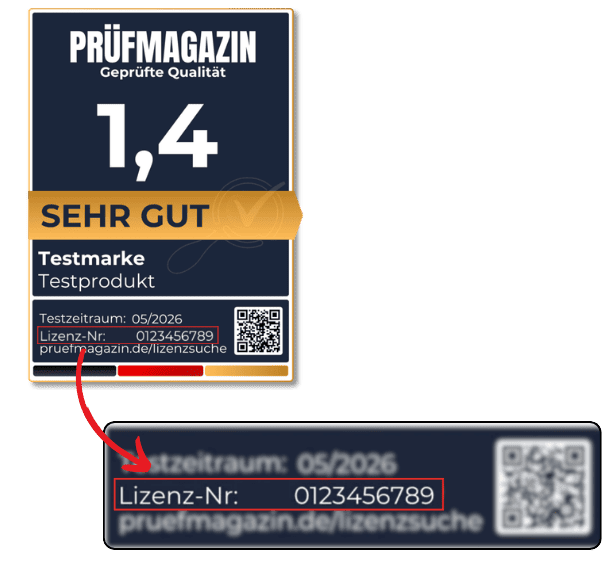
The PM seal condenses a comprehensive test into a few key figures.
- 1 The key data on the seal Every test seal shows the licence number, test period and overall grade achieved — the key figures at a glance.
- 2 What the grade says The overall grade condenses all test parameters into one reliable result.
- 3 The full test report The licence number opens the complete report with every individual rating — the basis for an informed buying decision.
- 4 Security The licence number links every seal to one verified certification and rules out tampered or unauthorised seals.
Helpful answers
Frequently asked questions about product testing
Answers on neutrality, scoring and how product tests are carried out.
01 How is the transparency of test results ensured?
Test results are fully documented and published. All evaluation criteria and individual results are open to view — so the testing process can be traced.
02 How is a product’s overall grade calculated?
The overall grade combines all test parameters according to their weighting. Each parameter contributes to the final grade in line with its weight. You will find the exact key in the evaluation handbook.
03 Who carries out the product tests?
Tests are carried out by product testers with specific expertise in the respective product categories. They follow fixed criteria defined for each product group and are fully documented.
04 Are products also tested independently of the manufacturer?
Yes. Part of our testing is editorial: we buy products in retail and test them to the same PM standard. Products are selected based on tips from consumers and our own research into categories in demand.
05 Can a manufacturer have a poor result changed afterwards?
No. Once established, a result is final and is not adjusted afterwards. The manufacturer does, however, receive an evaluation report showing where the product can be improved. A revised product can then be resubmitted — that is the very purpose of certification: demonstrable product improvement instead of polished grades. Test reports not withdrawn by the manufacturer remain published for the licence period.
06 How current are the test results?
Every published result is current. After passing the test, a product receives a licence that remains valid for as long as the product is unchanged and the licence itself is valid. If the product changes, it must be tested again.
07 How do I check that a test seal is genuine?
Every test seal carries an individual licence number. Enter it in the licence check to confirm that the seal is genuine and valid, and to view the full test report with every individual result.