






About us
We measure
what others claim
We test products physically, against a fixed testing standard, and publish every measured value. We pass no verdict — we supply the figures that any advertising claim has to stand up to.
90,000
readers a month, researching before they buy
500+
published tests, each one open to inspection
Why we exist
The market stopped measuring
On marketplaces, everything that looks like testing has long since become advertising. Four findings that anyone who has looked closely will recognise.
01
Five brands, one factory
The same device leaves the same production line under several names. One of them carries a logo and costs twice as much. Price no longer says anything about the product — only about the marketing behind it.
02
Reviews are a commodity
Positive ones are bought, critical ones disappear. Counting stars means counting budgets, not experiences. The last instance buyers relied on has fallen away.
03
Whoever pays gets recommended
Comparison sites rank products they have never held. The order follows the commission. What sits at the top is not the best product, but the most profitable one.
04
Ordering replaces comparing
With nothing to check beforehand, people order three and send two back. Research moves into the cardboard box. It is paid for in time, in margin and in every shipment.
Both sides lose: the buyer, and the seller with the good product.
Our role
We don’t advertise.
We measure and report.
Between buyer and manufacturer, the common ground has gone. We rebuild it — in a way that serves both sides. The buyer gets figures instead of stars. The manufacturer gets evidence that nobody can buy, including themselves.
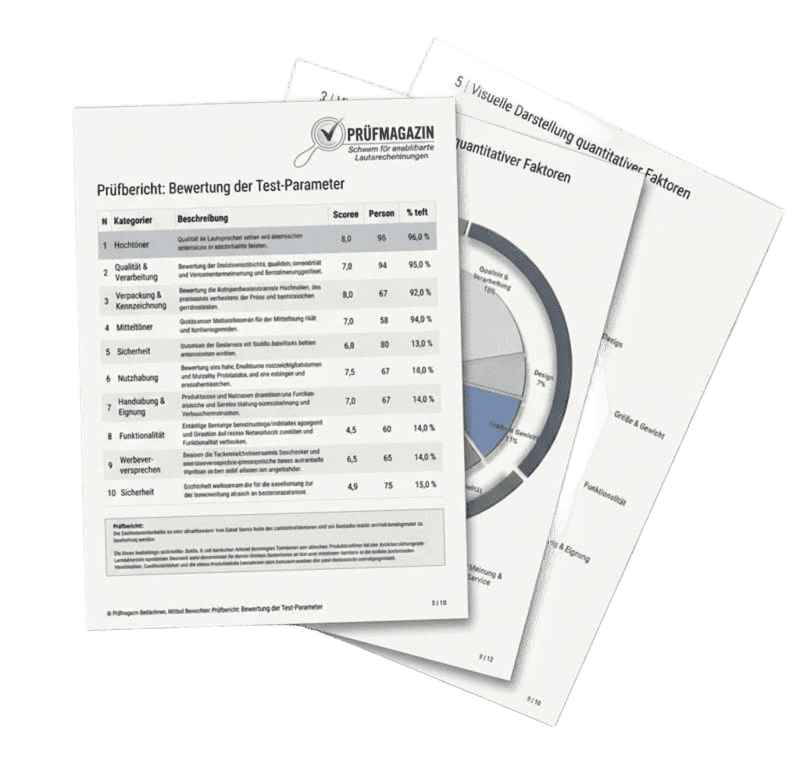
Ten test parameters, the same for every sample
Method, procedure and weighting disclosed
Every measured value in the report, not just the grade

The value
The result is not the grade — it is the measurement
An overall grade is a summary, and every summary loses information. Whether a product suits you is your decision. What we supply is the basis for it: editorial test reports with every individual value.
01
Figures, not stars
Weight, runtime, noise level, force required: Measured under identical conditions, for every sample in the same group. Values can be compared. Star ratings cannot.
02
Your requirement counts
Whether 340 grams is too heavy depends on who holds the device. We do not rate preferences — we publish the individual values against which anyone can check their own requirement.
03
Evidence, not advertising
For manufacturers the test is quality assurance: The protocol shows, parameter by parameter, where to improve. A revised product can be submitted again.
Testing team
Four perspectives on one product
Prüfmagazin is an interdisciplinary team. We come from purchasing, from retail, from e-commerce and from engineering — four perspectives that achieve little on their own and cover a product completely together.
The buyer sees the manufacturing, the retailer knows the complaint, the product manager the intended purpose, the engineer turns all of it into a measured value. What each one contributes is set out here.
01 Purchasing
Anyone who has bought goods for years can read seams, panel gaps and material thickness — and tell which production stands behind them, and which saving will show up later. That reading is where every test starts: it tells us where to look more closely on this particular product.
02 Retail
Return reasons are the market’s most honest feedback. They show where a product actually fails in daily use — rarely against the figures on the data sheet, almost always in handling, in fit, or against an expectation the product page created. Our test criteria come from there.
03 E-commerce and product management
A product is built for a particular purpose and advertised to a particular buyer. Where the two diverge, disappointment follows — even with flawless manufacturing. So we test against the claim the product presentation makes for itself.
04 Engineering
An assumption becomes a finding only once it can be measured. Test setup, quantity and repeatability are fixed in the PM testing standard: identical conditions, identical parameters, identical weighting. Only then does a result hold up to comparison — and to being checked.

Scope
Where our findings end
A result is credible partly because it states what it does not claim.
Snapshot
What we measure is the condition of the sample during the test period. We do not test how a product behaves over years — which is why the test period appears on every seal.
Classification
The grade condenses ten parameters using a disclosed key. It places a product — it does not replace weighing up your own intended use.
Coverage
We test what is submitted. A missing seal is therefore no statement about a product — only a statement about a test that has not taken place.