









Sample report
Lindqvist Serena SL-3 tested: deep bass, exposed drivers
Sample report. This page shows the structure and scope of a test report. Product, values and licence number are entirely fictitious.
Overview
Results by rating area
The test is divided into three rating areas with ten parameters in total.
The chapters below break down each area in turn.
Product-specific properties
- Quality & workmanship92 %
- Design95 %
- Size & weight86 %
Use and safety
- Functionality95 %
- Handling & suitability95 %
- Safety90 %
Opinion and service
- Advertising claims93 %
- Consumer opinion90 %
- Packaging & labelling100 %
- Value for money83 %
Not every parameter carries the same weight. The weighting is part of the PM Standard and documented in the testing procedure.
Verdict
Summary of the test results
The verdict sums up findings, limitations and suitability. The chapters below provide the evidence.
The verdict is written once all ten test parameters are complete.
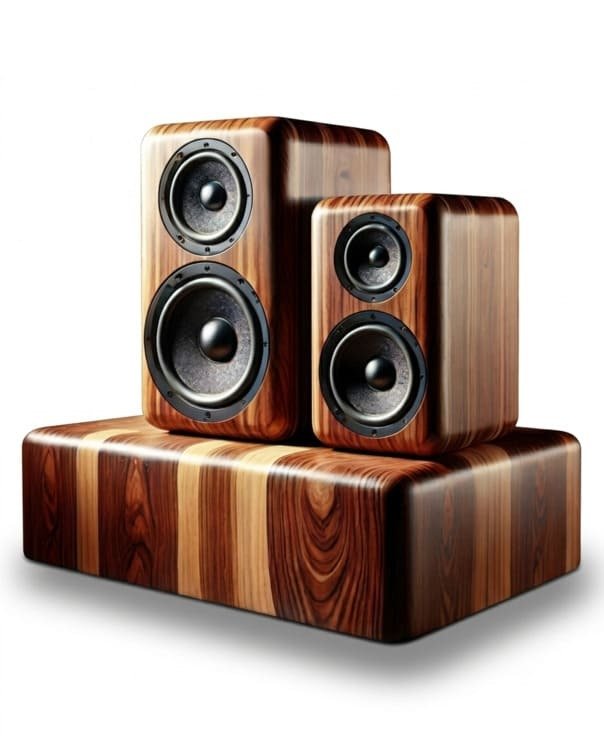
Compact systems usually fall short on bass. Either it is missing, or it calls for an extra box that needs a home somewhere in the room. The Serena SL-3 sidesteps this dilemma by moving the subwoofer into a plinth of solid walnut and maple. The two satellites sit on top, and from the outside nothing hints at technology. In the listening room, the bass reaches down to 34 Hz, a figure that pure stereo systems of this size do not achieve.
That this is a product of its price class shows in the materials. Solid wood instead of veneer, a multi-layer piano lacquer, FSC-certified origin and a serial number for every system: here, craftsmanship is not a backdrop but a design principle. The technology is no less accomplished. The satellites receive their signal wirelessly at 24 bit and 96 kHz, in sync and without audible delay. Streaming, HDMI eARC, a phono input and room calibration via smartphone make the system a complete set-up that needs neither an amplifier nor a separate source.
The Serena SL-3 makes no secret of its quirks; you simply need to know them. On the plinth, the satellites are just 42 cm apart, so the soundstage stays narrow. Anyone who wants a wider stereo image takes the satellites off, and each then needs its own mains socket. The drivers are exposed and there is no front grille, which dictates placement in homes with children or pets. The piano lacquer shows every fingerprint, and the solid wood needs a stable indoor climate. Finally, at 22.5 kg and with a footprint of 460 × 300 mm, the system calls for a piece of furniture that is up to the job.
At €2,190.00, the price sits in the upper middle of the class. Given the materials, features and five-year warranty, it is justified, even though two competitors include a front grille that is missing here. The premium over veneered systems is mainly down to the wood.
The Serena SL-3 is aimed at people who want to show off their system rather than hide it, and who are prepared to give it a permanent place. Anyone looking to bring music, television and a turntable together in a single piece of furniture will find one of the most consistent solutions in its class. Those who like to rearrange freely or have small children at home, on the other hand, should weigh up the points above honestly before buying.
What these parameters test
We assess material quality and craftsmanship: whether the materials used withstand the stated load and whether joints and surfaces are cleanly finished.
We look at form and colour in relation to function: whether the design supports operation or gets in its way.
Dimensions and weight are measured and set against the stated purpose: whether the product can be moved, stored and used as intended.
Rating area 1
Product-specific properties
We test what the product is made of, how it is built and whether its dimensions and weight suit the stated purpose.
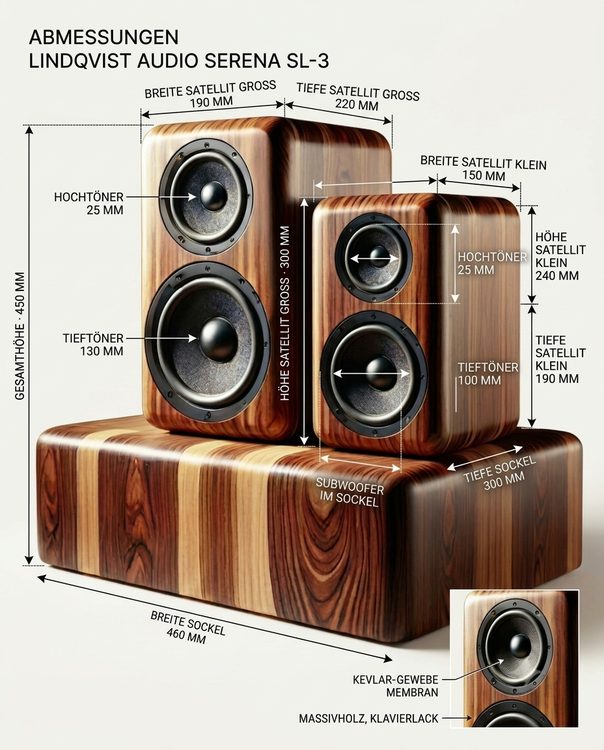
Lindqvist uses solid walnut rather than veneer for this system, and that shapes the quality & workmanship from the first touch. The cabinets are milled from glued laminations and braced internally; the plinth alternates walnut and maple. The multi-layer piano lacquer is evenly applied, and joints and edges are cleanly finished. The wood comes from FSC-certified forestry, and every system carries its own serial number. Technically, the interior follows the same line: all three woofers use woven Kevlar cones, from 200 mm in the plinth to 100 mm in the small satellite, while silk domes handle the treble. Two reservations remain. The drivers are exposed, and the manufacturer provides no cover. And solid wood calls for care with the indoor climate: Lindqvist specifies a relative humidity of 40 to 60 per cent. In dry winter months, that may mean a humidifier. How wood and lacquer age over the years could not be tested in five days.
In its design, the Serena SL-3 avoids any technical gesture. The grain of the walnut carries the satellites, and the plinth shows a calm pattern of dark and light laminations. Amplifier, connections and subwoofer disappear inside, and no screws are visible from the outside. That the two satellites differ in size seems unusual at first glance. It is a deliberate choice that gives the ensemble a certain liveliness without upsetting its order. Sonically, the electronics compensate for the difference. In a living room, the system looks more like a piece of furniture than a hi-fi, and that is precisely its ambition. The piano lacquer is one price of this effect. It shows every fingerprint, and even a dry cloth leaves fine marks under pressure. Anyone who moves the system regularly or often takes the satellites off will reach for the polishing cloth more often than they would like.
Solid wood is heavy, and that determines the score for size & weight. At 22.5 kg, the system is well above its class, which ranges from 10 to 20 kg. The plinth accounts for the largest share at 13.2 kg. In return, the design saves space elsewhere: the subwoofer sits in the plinth and needs no cabinet of its own that would need a home somewhere in the room. The satellites measure 190 × 300 × 220 mm and 150 × 240 × 190 mm and, at 5.6 and 3.7 kg, are easy to lift off individually. The plinth itself takes up a footprint of 460 × 300 mm. A sideboard therefore needs to be deep enough; an ordinary bookshelf will not usually do. The manufacturer offers no wall bracket for the satellites. Anyone who wants to place them away from the plinth needs their own stands or a second piece of furniture of suitable height.
What these parameters test
We check whether the promised functions are present and work reliably under real conditions, measured against the specification, not the advertising.
We assess operation in practical use: the effort required, how clear the controls are and suitability for the advertised environment.
We examine protective mechanisms, warnings and behaviour at the limits of use.
Rating area 2
Use and safety
We test whether the product delivers what it promises in use, and whether it puts anyone at risk in doing so.
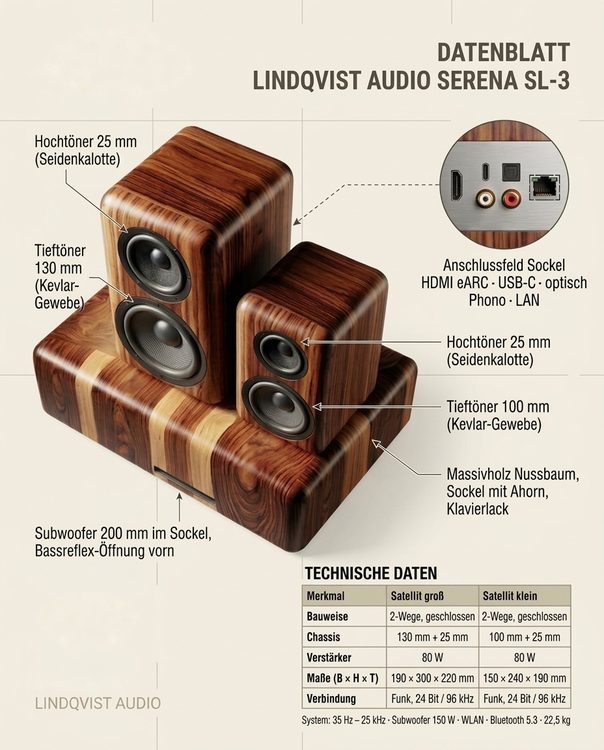
In terms of functionality, the measurements leave little to criticise. In the listening room, the bass reaches down to 34 Hz, the upper third of the 2.1 class, which ends between 30 and 40 Hz. Even at 106 dB at 1 m, the bass reflex port stays silent. The satellites receive their signal over a dedicated wireless link at 24 bit and 96 kHz. That matches the upper end of what comparable systems transmit between their speakers. With a latency of 15 ms that is identical across all channels, the sound stays lip-synced with the television. Streaming via AirPlay 2, Google Cast, Spotify and Tidal Connect is part of the package, as is room calibration via smartphone. The weakness lies in the geometry. On the plinth, the satellites are only 42 cm apart, and for all the depth the system delivers, the soundstage gains little width. With the satellites taken off, the sound opens up, but the wireless link reaches only 8 m. In typical living spaces, that is enough.
Handling & suitability show that Lindqvist has thought about everyday use. Setting up via the app takes less than five minutes, including room calibration. The television connects via HDMI eARC, and its remote then controls the volume. For turntables there is a phono input, along with optical, USB-C and Bluetooth with aptX Adaptive and LDAC. On the plinth, the satellites draw their power through contacts, so no cable is needed. Things change once they are taken off. Each satellite then needs its own mains socket, and in many living rooms there is none where the speakers sound best. Two power supplies are included; extension leads may not be. Tone controls, finally, are available only in the app. On the unit itself, only the volume can be adjusted. Anyone who would rather do without a smartphone also does without bass and treble controls.
Electrical safety is carefully handled. Power supply and amplifier sit in the plinth, and on the plinth the satellites carry no mains cable. Even at high volume, the Class D amplifier does not noticeably warm the outside of the cabinet. After 20 minutes without a signal, the system switches off automatically. The wide plinth stands so steadily that a knock against the sideboard does not make the satellites wobble. The real risk concerns the device more than the people around it. Cones and domes are unprotected. A curious child’s hand or a cat’s paw is enough to dent a silk dome, and such damage cannot be repaired at home. Many systems in this class come with a front grille; the Serena SL-3 does not. In a household without children or pets, that is a footnote. For families, however, it is the most important question when choosing where to put it.
What these parameters test
Every advertised property is checked against the findings: what can be verified counts as delivered, what cannot remains open.
Existing user reviews are analysed for recurring patterns. Isolated opinions are not taken into account.
We check transport protection, the completeness of the contents and the mandatory labelling.
The market price is set against the measured performance, relative to the product category.
Rating area 3
Opinion and service
We test whether the product lives up to what its marketing promises, and how it fares in the judgement of those who already use it.
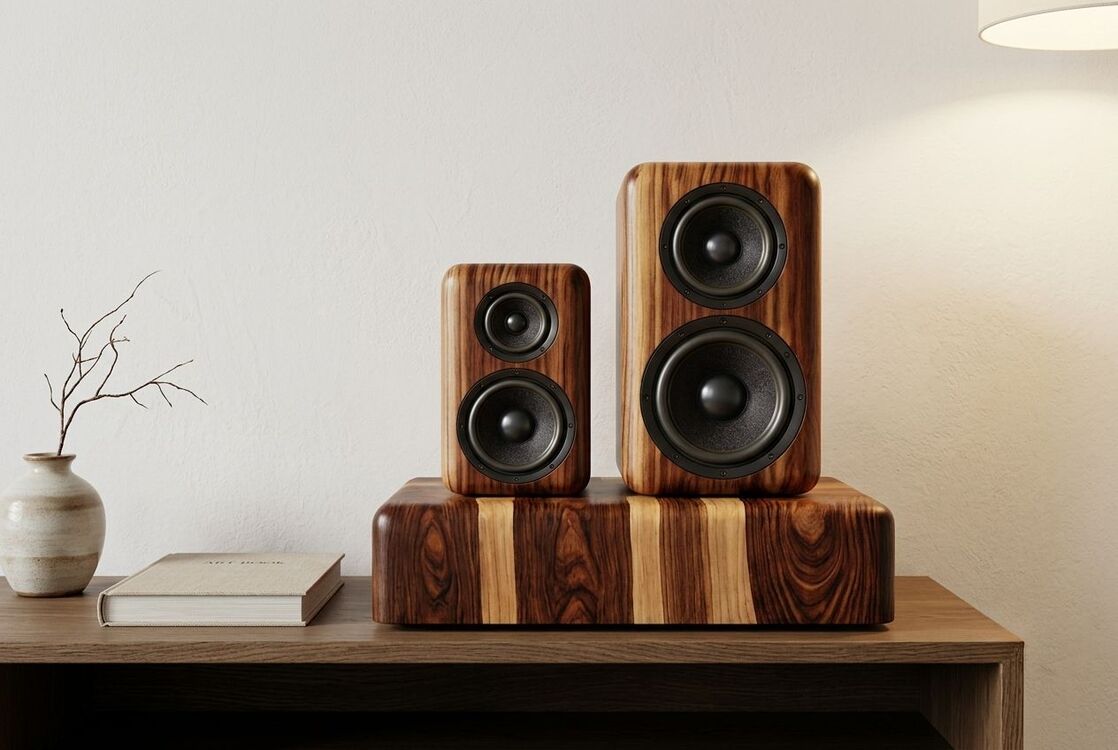
On its advertising claims, Lindqvist delivers wherever they can be checked. The wood is solid and comes from FSC-certified forestry. The cones are made of woven Kevlar. The stated frequency response of 35 Hz to 25 kHz matches the measurement; in the listening room, the bass even reached 34 Hz. The wireless connection of the satellites at 24 bit and 96 kHz is also as described, as are streaming, HDMI eARC and room calibration. One phrase deserves a qualification. The system is advertised with room-filling stereo sound. That holds true, but only once the satellites are taken off and placed further apart. On the plinth, as the system appears in every product image, the soundstage stays narrow with just 42 cm between the satellites. The manufacturer’s description does not address this difference. That does not make the claim false. It does, however, describe a set-up that buyers have to create themselves.
Consumer opinion is clearly positive and paints a picture consistent with the test. The system averages 4.6 stars from 312 ratings; a sample of 60 reviews was analysed. Buyers most often praise the sound, in 24 reviews. Wood and workmanship are highlighted in 21, streaming and the app in 14. The criticism is just as clear and remains limited. Eight reviews object to fingerprints on the piano lacquer, six miss a front cover. Five find the price high, usually adding that the materials and sound justify it. Not one review reports failures, dropouts or damage. Notably, the criticism concerns only finish and features, never function. The high star rating is therefore no accident. It reflects quite precisely what the reviews describe: a carefully built system with a few clearly identified quirks.
On packaging & labelling, the system offers no grounds for criticism. Plinth and satellites each sit in their own moulded foam insert, so the delicate piano lacquer stays protected at edges and corners too. CE and WEEE markings are on the unit, as are manufacturer, address and serial number. The manual is supplied in six languages, including German. It explains set-up, room calibration and how to take off the satellites. A dedicated section on caring for the wood stands out. There, Lindqvist states the recommended humidity range and describes how to clean the lacquer. For a product made of solid wood, this is more than a formality. The box also contains two power supplies for the detached satellites, two 3 m connecting cables, the remote control and an HDMI cable. Unpacked, the system can be run in every intended configuration without buying anything extra.
At €2,190.00, the system sits in the upper middle of its class, and that is the yardstick for its value for money. The comparison group ranges from €1,590 to €2,490. Compared with the Nordvik Aula Wireless, a veneered stereo pair without a subwoofer, the premium is €600.00. The gap to the Halden Studio Sub Set is €300.00. The Aurel Duo Wood and the Vessby Signature 2.1, both also made of solid wood, cost €100.00 and €300.00 more. For its price, the Serena SL-3 offers a rare combination: solid wood, subwoofer, streaming, HDMI eARC and wireless satellites in one package, plus a five-year manufacturer’s warranty. The Aurel Duo Wood does without HDMI, the Halden Studio Sub Set without solid wood. The comparison is less convincing on accessories. The cheaper Halden Studio Sub Set and the Vessby Signature 2.1 come with a front grille. The test sample does not.
Overall result
Conclusion of the test
The product underwent the full scope of testing. All qualitative and quantitative parameters were recorded on the basis of the rating parameters of the PM Standard.
The result meets the requirements for certification with the Prüfmagazin seal.
Scope, rating areas and weighting are documented in the testing procedure. The validity of a licence can be verified via the licence check.
Product tested
Manufacturer
Lindqvist Audio AB
Mustervägen 1, 211 00 Malmö, Sweden
Product