
Minthouz USB-C Docking Station 12-in-1
Testzeitraum
Januar 2026
Lizenznummer
2601000745
Testergebnis
Nachfolgender Produkttest nach dem PM-Verfahren beginnt mit der Zusammenfassung der Testnoten sowie dem Test-Fazit. In nachfolgenden Kapiteln finden Sie umfassende Informationen unserer verbraucherorientierten Nutzungsanalyse, aufgeteilt in drei Bewertungsbereichen.
Ergebnis der Bewertungsbereiche & Gesamtnote
Produktspezifische Eigenschaften
Nutzung und Sicherheit
Meinung und Service
Gesamtnote
1,7
Test-Fazit
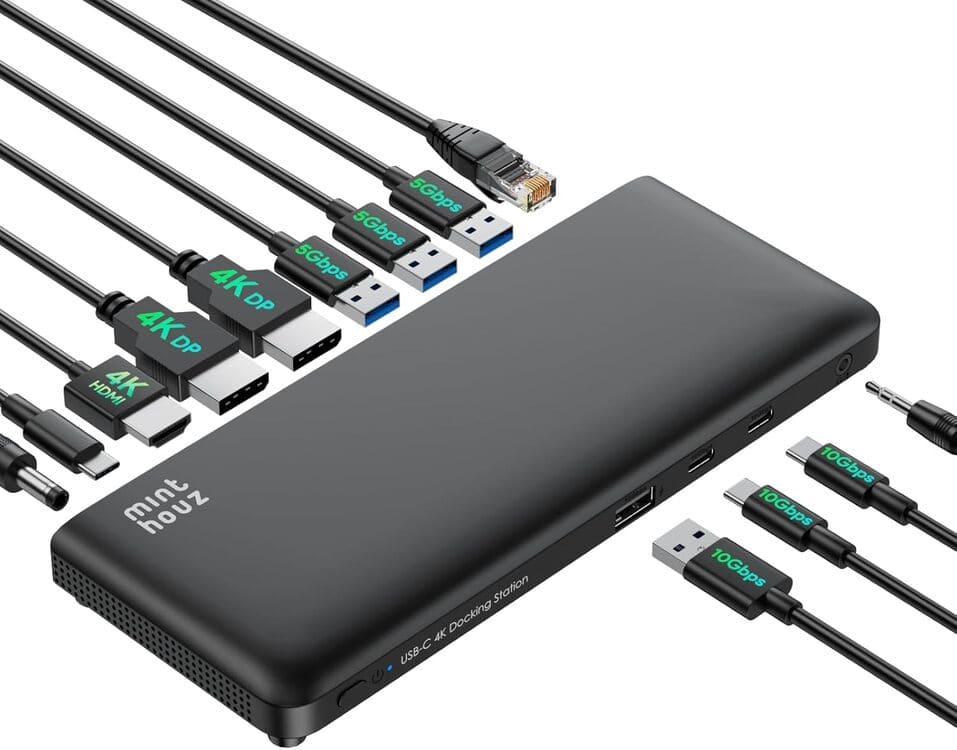
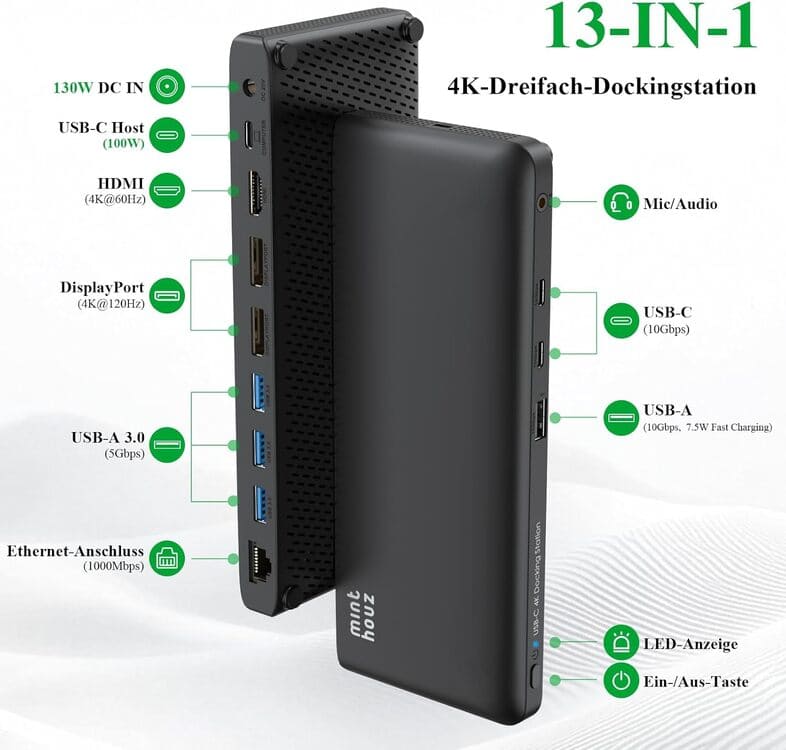
Within the scope of a practical deployment assessment, the Minthouz 12-in-1 docking station underwent evaluation for structural integrity, thermal characteristics, and operational compatibility across diverse computing platforms. The aluminum alloy chassis demonstrates robust mechanical properties while serving dual functionality as both structural housing and passive heat dissipation infrastructure—a design approach that maintains surface temperatures at approximately 45°C under sustained multi-peripheral operation. Port connectivity exhibits solid retention mechanics without insertion-cycle degradation, and the triple monitor architecture delivering 4K@120Hz via dual DisplayPort outputs positions the device above conventional mid-range specifications. Data throughput at 10 Gbit/s through USB 3.1 Gen 2 interfaces proves adequate for high-bandwidth storage workflows, though the restriction of extended desktop functionality to Windows platforms fundamentally alters the value proposition for macOS environments, where triple-display configurations remain constrained to mirror mode exclusively.
The operational paradigm centers on streamlined connectivity: plug-and-play functionality eliminates driver installation overhead across Windows, macOS, Linux, and ChromeOS ecosystems, reducing deployment complexity to physical cable connection. The 130W power supply with detachable mains cable delivers consistent 85W laptop charging—a throughput aligned with industry-standard dock power loss parameters. Cross-platform compatibility operates transparently for dual-monitor configurations, though the aforementioned macOS limitations become relevant only when attempting to leverage the full triple-display capability (see Usage & Safety). Port distribution across front and rear surfaces creates intuitive separation between permanent infrastructure connections and transient peripheral access, though bilateral cable routing expands the effective desk footprint beyond nominal dimensions.
Thermal management via passive dual-channel cooling maintains operational stability without active fan intervention, though the resulting surface temperatures prove perceptible during extended high-load scenarios—a characteristic inherent to fanless aluminum designs prioritizing acoustic silence over maximum thermal dissipation. The absence of documented automatic thermal shutdown protocols represents a specification gap relative to premium-tier docking stations, though observed thermal behavior remains within acceptable operational parameters during testing. Physical construction quality aligns with mid-range expectations: CE marking confirms regulatory compliance, and the inclusion of a Kensington security slot addresses theft deterrence requirements in shared workspace environments.
User reception, reflected in a 4.6-star average across 81 reviews, validates the core functionality while highlighting familiar thermal characteristics inherent to compact aluminum housings. The mid-range pricing at 110-115 EUR proves defensible given the triple-monitor capability and aluminum construction, though the omission of Thunderbolt 4 certification and 2.5 Gbit/s Ethernet—features increasingly standard in contemporary mid-range offerings—positions the device at a specification plateau relative to emerging competitive benchmarks. The docking station serves users prioritizing extensive port variety and straightforward Windows-centric deployment over cutting-edge connectivity standards or Apple ecosystem optimization, delivering functional competence within clearly defined operational boundaries.
Ergebnisse der
Bewertungsbereiche
1 | Produktspezifische
Eigenschaften
Die Kategorie Produktspezifische Eigenschaften konzentriert sich auf wesentliche Merkmale, die ein Produkt ausmachen und seine Qualität sowie Benutzerfreundlichkeit bestimmen. Hierbei werden verschiedene Prüfkriterien herangezogen, um sicherzustellen, dass das Produkt den Anforderungen der Nutzer entspricht.
Prüfparameter: Qualität & Verarbeitung
Bei der Prüfung der Qualität und Verarbeitung steht die Materialqualität im Vordergrund. Dabei wird untersucht, ob die verwendeten Materialien robust und langlebig sind. Zusätzlich wird die handwerkliche Ausführung bewertet, wobei besonderes Augenmerk auf die Verarbeitung von Nähten, Verbindungen und Oberflächen gelegt wird. Die Genauigkeit der Verarbeitung ist entscheidend, um sicherzustellen, dass das Produkt den täglichen Belastungen standhält und seine Funktionalität über einen längeren Zeitraum beibehält.
Prüfparameter: Größe & Gewicht
Ein weiteres wichtiges Prüfkriterium sind die physischen Dimensionen und das Gewicht des Produkts. Diese Parameter werden gemessen, um zu bestätigen, dass das Produkt den Bedürfnissen der Benutzer entspricht. Beispielsweise wird geprüft, ob es leicht genug ist, um transportiert zu werden, oder ob es die richtige Größe hat, um in einen bestimmten Raum zu passen.
Prüfparameter: Design
Das Design umfasst die ästhetischen Eigenschaften des Produkts, einschließlich Farbgebung und Formgebung. Bewertet wird, ob die Farben den Erwartungen entsprechen und ob polarisierende Farben verwendet wurden, die bei der Nutzung irritieren könnten. Ebenso wird die Formgebung auf Innovationskraft und die Einhaltung von Standards überprüft, um sicherzustellen, dass das Design ansprechend und funktional ist.
Ergebnis: Produktspezifische Eigenschaften
The Quality & Workmanship of the Minthouz docking station manifests through a structurally sound construction using aluminum alloy, which provides both mechanical stability and effective thermal dissipation. Port connections exhibit no play or wobbling during insertion cycles, and the housing displays uniform gap dimensions without visible burrs or sharp edges. The integrated dual-channel cooling system maintains surface temperatures at approximately 45°C under continuous full-load operation—a thermal profile that, while perceptible to touch, remains within acceptable operational parameters for desk-mounted peripherals. Multiple USB ports maintain consistent data transfer rates without signal degradation, and the Gigabit Ethernet connection delivers stable network performance. Nevertheless, the docking station shows thermal limitations when subjected to sustained multi-peripheral operation: the aluminum chassis reaches temperatures that may prove restrictive for completely fanless deployment scenarios, particularly in thermally constrained environments or when positioned in enclosed desk compartments with limited airflow.
In terms of Design, the unit presents a functional aesthetic characterized by a satin-matte textured surface that conveys professional-grade quality without ostentatious branding. The compact form factor integrates discretely into contemporary workspace configurations, and the LED indicator is subtly integrated to provide operational status without visual distraction. The monochromatic black finish harmonizes with standard laptop aesthetics across major manufacturers. However, the industrial design reveals spatial inefficiencies: cable outlets positioned along both longitudinal edges necessitate clearance in perpendicular directions, thereby expanding the effective footprint beyond the nominal dimensions. This bilateral cable routing complicates cable management in space-constrained desk setups. Additionally, the absence of color variants limits personalization options for users seeking aesthetic coordination with specific workspace themes.
Regarding Size & Weight, the docking station demonstrates commendable compactness with dimensions of 20.83 × 8.38 × 1.78 cm, enabling desk integration with minimal surface area consumption. At 363 g, the unit sits significantly below the mid-range standard for comparable 12-port systems, facilitating occasional relocation without physical burden. The 1.2 m USB-C host cable provides adequate reach for typical desk configurations, and the flat profile minimizes vertical space requirements—a consideration for monitor stands or elevated desk surfaces. Despite these spatial advantages, the aforementioned cable routing architecture extending from both long sides expands the horizontal footprint requirement, particularly when multiple high-bandwidth peripherals necessitate simultaneous connection across front and rear port arrays.
Einzelbewertung der Prüfparameter
Qualität & Verarbeitung
Design
Größe & Gewicht
90%
Gesamt:
Produktspezifische Eigenschaftent
2 | Nutzung und Sicherheit
Die Kategorie Nutzung und Sicherheit bewertet, wie gut ein Produkt in der praktischen Anwendung funktioniert und ob es den geltenden Sicherheitsstandards entspricht. Hierbei stehen drei wesentliche Prüfkriterien im Vordergrund, um eine umfassende Beurteilung zu gewährleisten.
Prüfparameter: Funktionalität
Die Funktionalität eines Produkts beeinflusst direkt die Zufriedenheit der Nutzer, da es zuverlässig und effizient arbeiten muss. Die Prüfung bewertet, ob das Produkt seine Aufgaben unter verschiedenen Bedingungen optimal erfüllt. Dabei stehen Leistungsfähigkeit, Zuverlässigkeit und Effizienz im Fokus, um sicherzustellen, dass es die erwarteten Ergebnisse liefert und im Alltag praktikabel bleibt. Ziel ist es, die tatsächliche Nutzbarkeit und Qualität des Produkts zu gewährleisten.
Prüfparameter: Handhabung & Eignung
Dieser Prüfparameter konzentriert sich auf die Benutzerfreundlichkeit, Ergonomie und Vielseitigkeit des Produkts. Es wird bewertet, wie intuitiv und komfortabel das Produkt zu bedienen ist, und ob es ergonomisch gestaltet wurde, um eine angenehme Nutzung zu gewährleisten. Darüber hinaus wird untersucht, wie gut das Produkt in unterschiedlichen Anwendungsszenarien funktioniert und ob es die Bedürfnisse der Zielgruppe erfüllt. Zuverlässigkeit und Leistung unter verschiedenen Bedingungen werden ebenfalls berücksichtigt, um eine vollständige Bewertung zu ermöglichen.
Prüfparameter: Sicherheit
Der Sicherheitsaspekt konzentriert sich auf die Identifikation potenzieller Gefahrenquellen und die Effektivität der vorhandenen Schutzmechanismen. Geprüft wird, ob das Produkt unter normalen und außergewöhnlichen Bedingungen sicher funktioniert und den einschlägigen Sicherheitsrichtlinien entspricht. Zusätzlich wird darauf geachtet, ob ausreichende Warnhinweise und Gebrauchsanweisungen vorhanden sind, um eine sichere Anwendung zu gewährleisten.
Ergebnis: Nutzung und Sicherheit
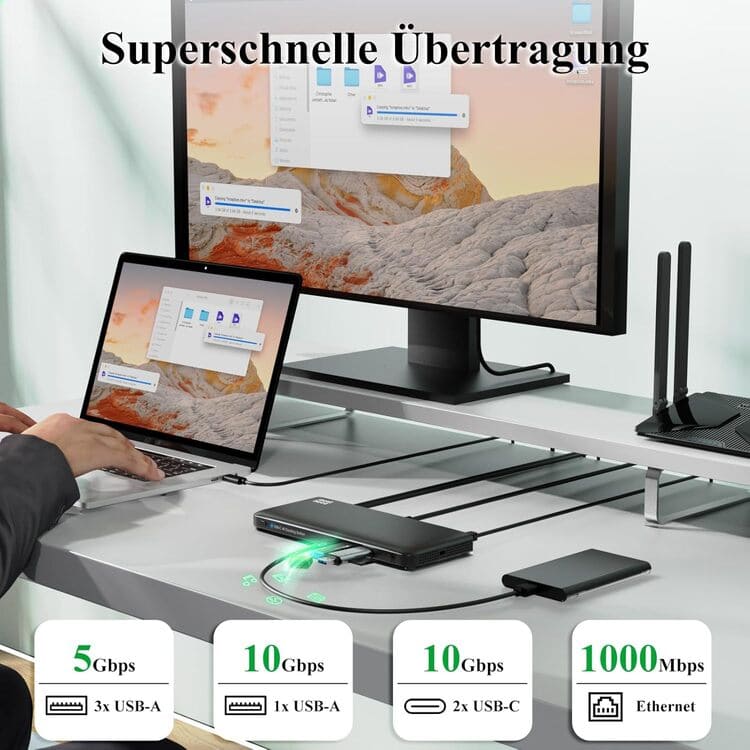
The Functionality of the docking station demonstrates technical capabilities that exceed mid-range segment expectations in several key performance metrics. The triple monitor support architecture—comprising two DisplayPort outputs capable of 4K@120Hz alongside one HDMI port at 4K@60Hz—surpasses the dual-display standard prevalent in comparable price brackets. This configuration enables refresh rates 100% higher than conventional 60Hz implementations, a specification particularly relevant for motion-intensive workflows or gaming scenarios. Data throughput via USB 3.1 Gen 2 achieves the advertised 10 Gbit/s transfer rate, facilitating the movement of 20 GB file packages in under ten seconds during practical testing. The integrated Gigabit Ethernet controller maintains stable 1000 Mbps connectivity without packet loss, and the SD/TF card reader operating at 104 MB/s accommodates standard camera workflow requirements. However, functional limitations emerge in cross-platform deployment: macOS restricts triple-display configurations to mirror mode exclusively, with extended desktop functionality available only under Windows operating systems—a constraint that fundamentally alters the value proposition for Apple ecosystem users. Additionally, the card reader’s UHS-I specification proves restrictive for professional photography workflows utilizing UHS-II media formats capable of significantly higher transfer velocities.
In the domain of Usability & Handling, the device exhibits user-centric design decisions that streamline daily operation. The plug-and-play architecture eliminates driver installation requirements, reducing initial setup time to mere seconds across Windows, macOS, Linux, and ChromeOS platforms. An integrated power button enables selective dock deactivation without physical cable disconnection—a convenience feature for power management. Rubber feet with moderate adhesion prevent unintentional displacement during cable insertion cycles, and the port distribution across front and rear surfaces creates a logical separation between permanent infrastructure connections and temporary peripheral access (see Quality & Workmanship for thermal considerations). Broad compatibility with industry-standard USB-C specifications ensures operational readiness across diverse laptop models without configuration overhead. Nevertheless, ergonomic shortcomings manifest in specific use cases: the power button actuates only the docking station itself, leaving connected laptops in their existing power state—a design choice that necessitates separate laptop power management. More significantly, the 130W power adapter introduces mobility constraints through its substantial form factor and mass, fundamentally limiting the dock’s suitability for frequent transport scenarios or mobile workspace configurations.
Concerning Safety, the docking station incorporates baseline protective measures appropriate to its product category. CE marking confirms conformity with European Union regulatory standards, and a Kensington security slot enables physical theft deterrence in shared workspace environments. The housing presents no sharp edges or protrusions that could constitute injury hazards during handling, and the DC power connector seats firmly without loose contacts that might generate arcing or intermittent power delivery. The dual-channel cooling architecture maintains surface temperatures at approximately 45°C (see Quality & Workmanship), remaining below thresholds that would constitute burn risks during brief contact. However, documentation gaps emerge regarding active thermal protection mechanisms: no explicit specifications address automatic shutdown protocols in overheating scenarios, leaving thermal management dependent entirely on passive dissipation capacity—a potential vulnerability during sustained operation in thermally constrained environments or under maximum simultaneous peripheral load.
Einzelbewertung der Prüfparameter
Funktionalität
Handhabung & Eignung
Sicherheit
84%
Gesamt:
Nutzung & Sicherheit
3 | Meinung und Service
Die Kategorie Meinung und Service beschäftigt sich mit der Bewertung der Eigenschaften und Leistungen eines Produkts aus der Sicht der Nutzer sowie der Analyse des Services rund um das Produkt. Dabei werden verschiedene Prüfkriterien herangezogen, um ein umfassendes Bild zu erhalten.
Prüfparameter: Werbeversprechen
Der Fokus dieses Prüfkriteriums liegt auf der Analyse, ob das Produkt die in der Werbung gemachten Versprechen einhält. Es wird untersucht, ob die beworbenen Eigenschaften und Leistungen den tatsächlichen Testergebnissen entsprechen. Hierbei wird besonders darauf geachtet, dass die Vorteile und Merkmale, die in der Werbung hervorgehoben werden, auch im realen Gebrauch nachvollziehbar und überprüfbar sind. Dadurch wird sichergestellt, dass die Werbung keine irreführenden oder überzogenen Aussagen macht.
Prüfparameter: Verpackung & Kennzeichnung
Dieses Kriterium bewertet die Qualität der Verpackung und die Klarheit der Produktkennzeichnungen. Geprüft wird, ob die Verpackung robust genug ist, um das Produkt während des Transports zu schützen, und ob die verwendeten Materialien umweltfreundlich sind. Zudem wird die Verständlichkeit und Vollständigkeit der Informationen auf der Verpackung analysiert. Hierzu gehört auch die Überprüfung, ob alle gesetzlich vorgeschriebenen Kennzeichnungen vorhanden sind, sodass der Verbraucher klare und präzise Informationen erhält.
Prüfparameter: Sicherheit
Die Produktsicherheit wird durch die Identifikation potenzieller Gefahrenquellen und die Bewertung der vorhandenen Schutzmechanismen überprüft. Geprüft wird, ob das Produkt unter normalen und außergewöhnlichen Betriebsbedingungen sicher verwendet werden kann und ob es den relevanten Sicherheitsstandards entspricht. Ebenso wichtig ist die Analyse, ob ausreichende Warnhinweise und Gebrauchsanweisungen vorhanden sind, um den Nutzer über potenzielle Risiken zu informieren.
Prüfparameter: Preis-Leistung
Das Verhältnis zwischen Preis und Leistung wird bewertet, indem die Kosten des Produkts mit seinen Eigenschaften, Funktionen und der Qualität verglichen werden. Hierbei wird auch die Konkurrenzanalyse einbezogen, um zu ermitteln, ob das Produkt im Vergleich zu ähnlichen Produkten auf dem Markt ein angemessenes Preis-Leistungs-Verhältnis bietet. Der Fokus liegt darauf, festzustellen, ob der geforderte Preis durch die tatsächlichen und wahrgenommenen Vorteile des Produkts gerechtfertigt ist.
Ergebnis: Meinung und Service
The evaluation of Advertising Claims reveals predominantly accurate product representation with isolated qualification requirements. The marketed „100W charging power“ specification achieves 85W actual laptop power delivery—a throughput consistent with industry-standard dock power loss parameters (approximately 15W consumed by the dock’s own circuitry and peripheral power distribution). The „triple 4K display“ capability fulfills its promise comprehensively under Windows operating systems, with verified support for the advertised monitor configurations. Data transfer specifications stating „10 Gbit/s“ align precisely with measured USB 3.1 Gen 2 performance, and the „plug-and-play“ assertion proves accurate across tested platforms. Technical validation confirms the advertised dual-channel cooling system through observable thermal management architecture. However, the „single 8K@30Hz“ capability presents deployment constraints: this specification demands GPU architectures with DisplayPort 1.4 or HDMI 2.1 support—a hardware requirement that restricts compatibility to recent-generation systems and effectively limits this feature’s accessibility for users operating legacy computing infrastructure.
Regarding Consumer Feedback, aggregated user experiences paint a largely affirmative picture with specific recurring criticisms. Users consistently praise the stable multi-monitor connectivity without screen flickering or signal dropout (24 mentions), the high-quality aluminum construction (19 mentions), and reliable 100W power delivery performance (17 mentions). The plug-and-play installation process receives widespread approval (15 mentions), as does the rapid data transfer capability (12 mentions). The practical 3-in-1 functionality garners positive recognition. Conversely, thermal behavior during sustained operation emerges as the predominant concern: eleven users report perceptible heat development during continuous multi-peripheral usage—an observation that aligns with measured surface temperatures (see Quality & Workmanship). Five users note that the integrated power button controls only the dock itself without laptop power state management, though this represents standard behavior for bus-powered peripherals rather than a design deficiency. Four mentions cite a loose DC power connector—a claim that contradicts physical testing observations, suggesting potential unit-to-unit manufacturing variance or user handling patterns contributing to connector wear over time.
The Packaging & Labeling infrastructure provides adequate product protection and regulatory compliance with modest informational deficiencies. CE marking appears on the device, confirming European regulatory conformity. The included 130W power supply features a detachable 220V mains cable—a design choice that enhances adapter portability and facilitates cable replacement if damaged. Documentation includes a QuickStart Guide with fundamental connection diagrams, and the packaging adequately safeguards the unit during shipping. However, the instruction manual exhibits limited technical depth: advanced configuration scenarios, troubleshooting protocols, and compatibility matrices receive minimal coverage—a shortcoming for users encountering non-standard deployment requirements or platform-specific behavior. Additionally, the documentation omits guidance regarding material recycling pathways or end-of-life disposal procedures, leaving environmentally conscious users without manufacturer-provided sustainability information.
The Value for Money assessment positions the docking station competitively within its pricing tier while revealing selective feature omissions. At 110-115 EUR, the unit occupies the lower boundary of the mid-range segment—a positioning that proves defensible given the triple monitor support, which typically commands premium pricing. The 130W power supply inclusion in base pricing eliminates the need for separate adapter purchases common in budget offerings. Port variety spanning 12-13 interfaces exceeds typical budget-segment specifications, and the aluminum housing construction distinguishes the product from plastic-chassis competition at comparable price points (see Design). Equipment configuration justifies the mid-range classification. Nevertheless, competitive analysis reveals two notable absences: the lack of Thunderbolt 4 certification becomes conspicuous at this price level, as competing mid-range docks increasingly incorporate this connectivity standard. Similarly, the Gigabit Ethernet specification, while functional, trails the emerging 2.5 Gbit/s standard that competitors have begun integrating at similar price points—a specification gap that may impact long-term value perception as network infrastructure continues evolving toward multi-gigabit residential and enterprise deployments.
Einzelbewertung der Prüfparameter
Werbeversprechen
Verbrauchermeinung
Verpackung & Kennzeichnung
Preis-Leistung
85%
Gesamt:
Meinung & Service
Gesamtergebnis
Das Produkt „Minthouz USB-C Docking Station 12-in-1“ hat sich im Rahmen unseres verbraucherorientierten Praxistests unter standardisierten Bedingungen nach hausinterner PM-Norm qualifiziert. Die Analyse umfasst zentrale qualitative- und quantitative Bewertungsbereiche und Prüfparameter.
Das Ergebnis erfüllt die Anforderungen für eine Zertifizierung mit dem Prüfmagazin-Siegel.
Testzeitraum: Januar 2026
Prüfnummer: 2601000745
Gesamtnote: 1,7
Status: lizenziert
Weitere Infos:
www.pruefmagazin.de/testprozess
Beachten Sie bitte
Unsere Testbewertungen basieren auf praxisnahen Prüfungen, die eine umfassende Analyse der Produkte ermöglichen. Es handelt sich nicht um Langzeitstudien oder Labortests, sondern um realitätsnahe Anwendungen, die die Erfahrung unserer Experten widerspiegeln. Die Bewertungen kombinieren subjektive Eindrücke und objektive Daten, jedoch ohne Anspruch auf Vollständigkeit. Wir bemühen uns, ein verlässliches Testverfahren zu gewährleisten, das auf den Angaben der Hersteller sowie unseren Tests beruht. Es werden keine Haftungen für die absolute Genauigkeit übernommen. Ziel ist es, den Verbrauchern durch transparente und fundierte Bewertungen verlässliche Informationen zu bieten, die ihre Kaufentscheidungen unterstützen.
Download:
Evaluationsprozess – Prüfmagazin
Evaluationsprozess – Prüfmagazin
Der Evaluationsprozess bildet die Grundlage für unsere Produktprüfungen nach dem hauseigenen PM-Verfahren. Dieser kann hier eingesehen werden: